
Existence That Does Not Require Translation
A storytelling night in Vienna, on the theme of Home.

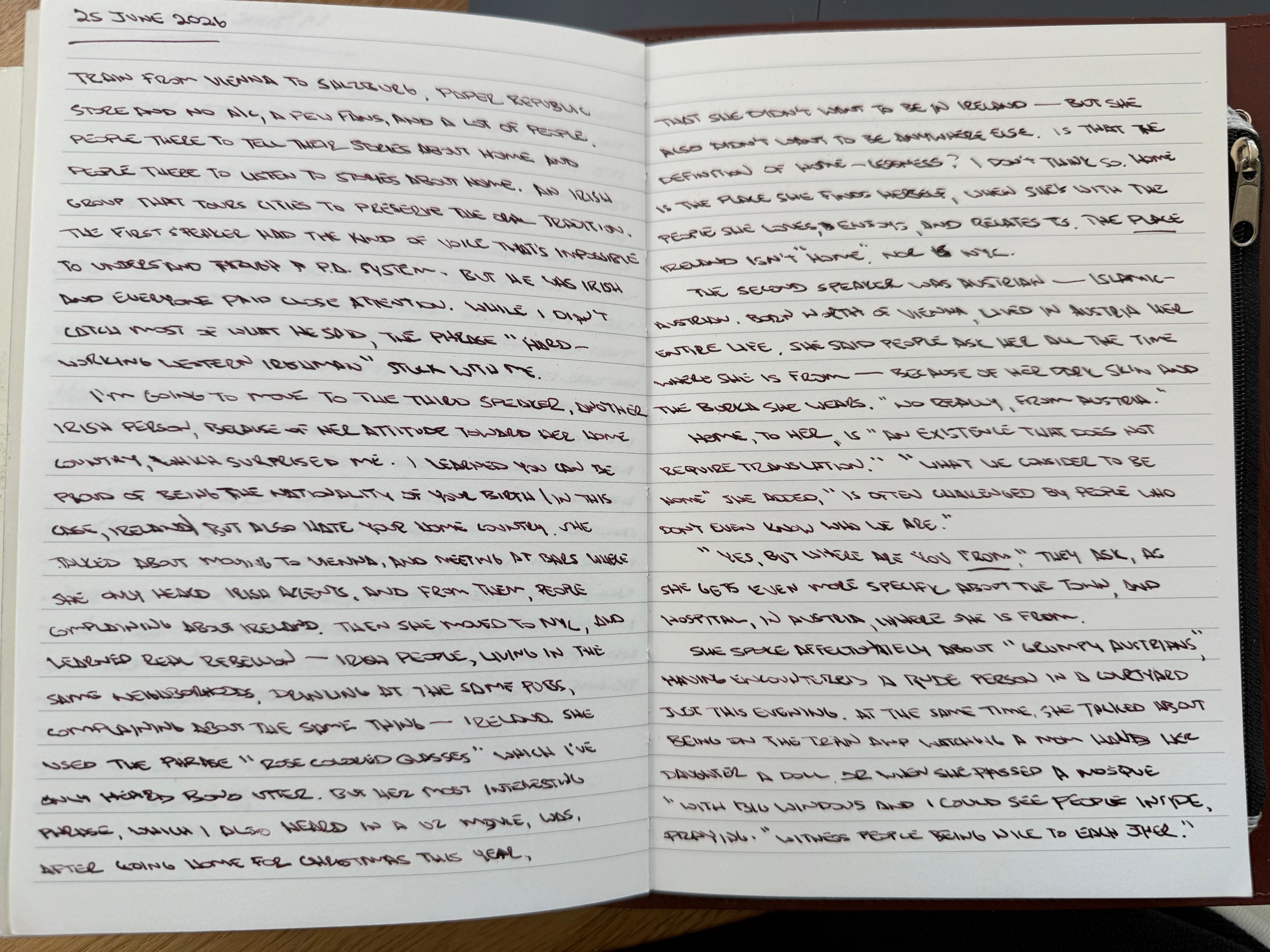
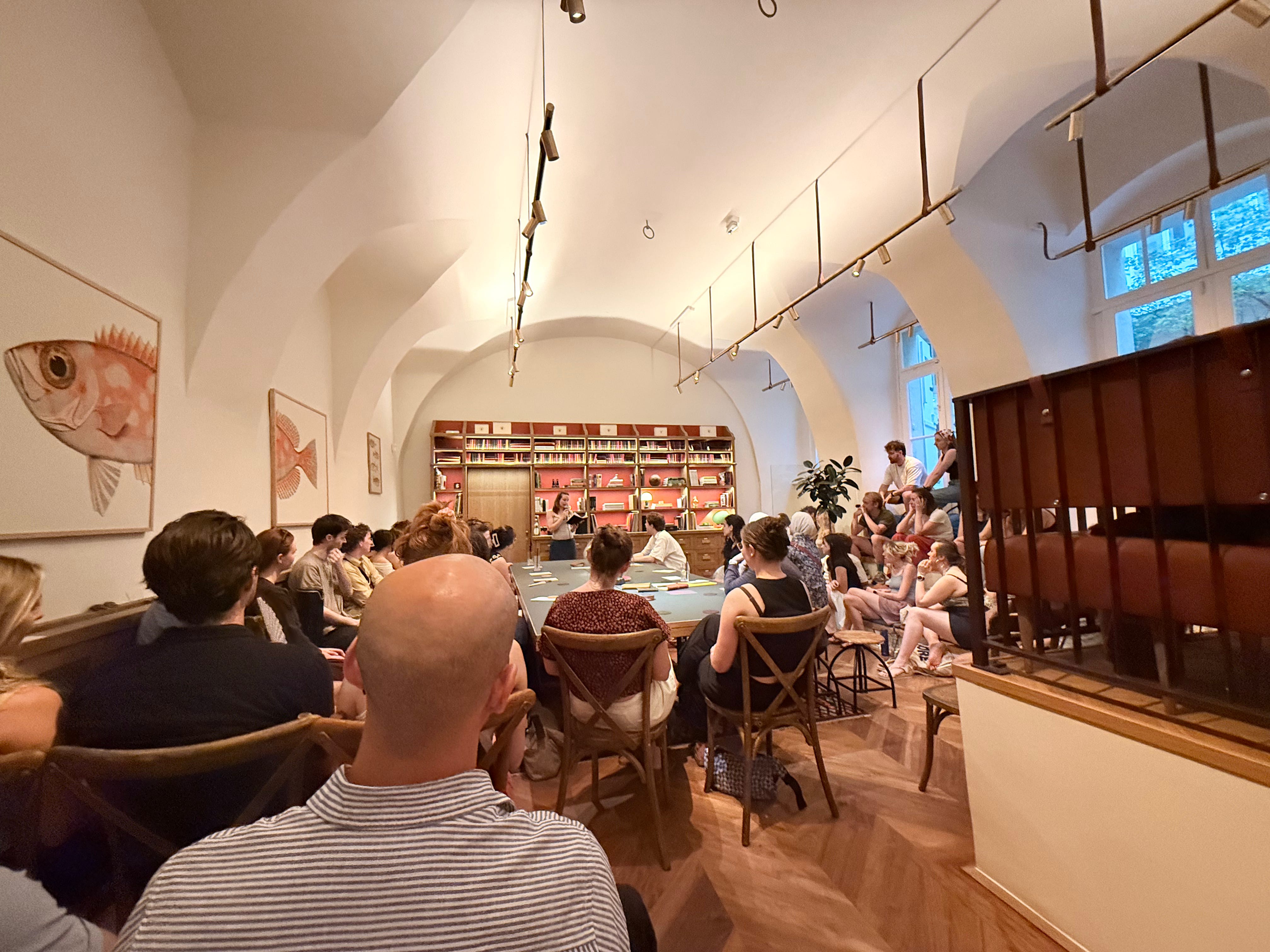
The Paper Republic flagship store in Vienna — whose leather journals and notebooks I have used for the last ten years — had no air conditioning last night. It’s Europe. And it’s hot. Nonetheless, several fans pushed the warm air politely from one person to the next in the space. I arrived in the evening for Seanchoíche, an Irish word, pronounced shanna-key-huh. It means storytelling night. Strangers gathered to listen to stories around a pre-planned theme: Home.
I was initially interested based on the format: using the oral tradition to communicate, in contrast to our current digital reality. These aren’t TEDx talks. They’re just extemporaneous speeches given by interesting people.
The first storyteller had a particularly throaty voice that defeats a room even through a microphone — verbal acoustics not made for amplification. The room leaned in anyway, because he was Irish, with a story about his grandfather, and that was more than enough. One particular phrase made it through to me intact — his grandfather’s great Western Ireland work ethic — and I have been stewing on it since, turning over how I’d describe the old-timers of my own country. This man, from what I could hear, derives his image of home not from a brown roof, or green pastures, or white cliffs, but from his grandfather. It was moving.
But the storyteller I keep returning to in my notes was Austrian. Islamic-Austrian; born north of Vienna, in the country her whole life. German is her mother tongue. Yet, she described how people ask her where she is from — constantly — on account of her dark skin and the burka she wears. No, really. I’m from Austria, she emphasized. As she must, most days. As soon as she stood to give her talk, I felt a tinge of judgement disguised as sympathy for her, cloth wrapping her head. As I mentioned, it’s been unbearably, dangerously hot in Austria, and across Europe, as of late.
Home, to her, is “an existence that does not require translation.” Oof. You can chuckle, cringe — or roll your eyes — at my naivety. The woman answered my judgement without even hearing the question.
She said it plainly, the way a person says a thing they have arrived at over seasons and experiences, rather than one which is inherited. What we call home, she said, powerfully, is often challenged by people who do not even know who we are. Yes, but where are you from, from? they press. She gives them the town, north of Vienna, and even the name of the hospital. And still it is not enough, because the question was never a question.
She was not bitter. The opposite, actually. She spoke affectionately about Austria. And grumpy Austrians, having met a rude one in the courtyard next to the shop that very evening. Someone complaining about noise from an event which had not even started. And yet, for every experience she faces daily, she had the most energy and emotion around examples of love and empathy. Watching a mother on the train hand her daughter a doll that had fallen, and the smile on the girl’s face when it was back in her arms. Or when she was passing a mosque with big windows and seeing, through them, people inside, praying. Those things make her smile.
She had come, it seemed, to decide to be a witness to people being kind to one another. And to count it.
Another storyteller, an Irishwoman, offered the other face of the same coin. You can be proud of the nationality you were born into, and still not love your country. Vienna gave her bars full of fun Irish nationals, all complaining about Ireland and how they would never return. New York gave her whole neighborhoods of her countrymen and -women. But the Irish, it turns out, in pubs and neighborhoods there, too, share many of the same grievances. For her at least, the rebellion of leaving had curdled into homesickness for the thing left. Rose-coloured glasses, she described, worn in Dublin, Vienna, and New York. This is a phrase I had also only heard from another Irish voice, Bono, describing Ireland. History I will never understand because I haven’t lived it. Closing out her story, describing this Christmas past, tears streaming down her face when the plane landed in Dublin from New York City. She didn’t want to be in Ireland.
But she did not want to be anywhere else, either.
Is that…homelessness? I don’t think so. I’m learning this myself, having moved my family from one country to another three years ago. These women had just made powerful arguments that a country is not always home, even when it is.
Home is the place a person finds herself when among the people she loves, and enjoys, and is understood by. And in moments of wholeness and kindness. Even when they are bookended by moments of judgment, or worse.
The Austrian woman in the burka had the cleaner word for this. The opposite of home is not exile. It is ‘translation.’ Being asked, again and again, to explain yourself to people who have decided in advance not to accept the answer.
My own foreignness in Austria is, overall, the comfortable kind. What I wear here — my skin color, gender, background, oh, an Austrian surname — makes the surface work easy; it opens doors and makes going through them easier. Initially, anyway. The harder thing I’ve never been able to name is what it takes to actually be home here. Learning, always, the language. The customs. The people. The culture. The unspoken rules.
That is, if I ever will call it home in the traditional sense. Or if that’s even the goal. Or, if I will find it by a different name, or mindset.
You know, that place, that existence, that needs no translation. Home.