
Algorithms of Joy
We need to talk about what we gave that word away to.

Algorithm. It sounds like something that lives in a server rack at a data center in rural Oregon, doesn’t it? Fed on clicks and demographic data, optimizing for a metric you never agreed to care about. It sounds like Facebook. Like TikTok. YouTube Shorts. Like the invisible hand that decided you needed to see that particular post at that particular moment when you were tired and sad and susceptible.
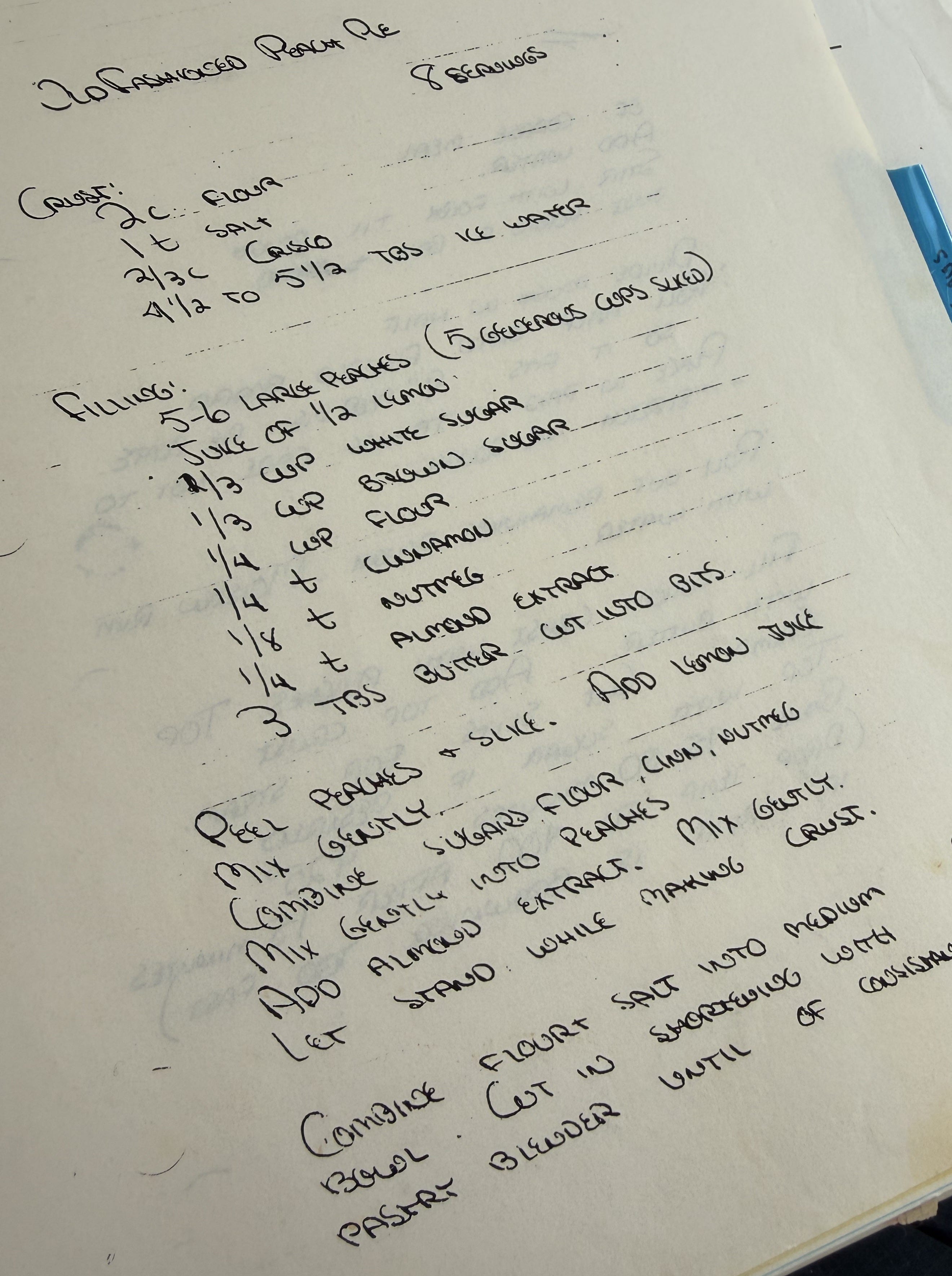
But really, an algorithm is just a set of instructions for making a decision. They’ve been around forever. Much longer than any social media service. A recipe is an algorithm. The method my mom used to bake her legendary Palisade peach pies (recipe below), that she learned from her mother, adjusted over decades of kitchens, ovens, and great butter (miss you, Mom, and your amazing pies). Or the path a salmon takes back upstream, even though the river has changed speed and depth. The way you’ve learned to take the long way home, even through the construction detours, when you needed a little more time to think.
These are also algorithms. They optimize for things that matter.
The ones that broke us, and the word, optimize for metrics like Engagement Rate, Minutes of Use per Month. For the click. For the spike of outrage that keeps you scrolling just past the point where you meant to stop (at two in the morning). They’re not designed to make you feel good. They’re designed to make you feel angry, or too proud, or like you’re missing out. Because those feelings keep you engaged. And being engaged online means money for someone else.
That’s the “algorithm” word we gave to them.
I’ve been thinking about how we might take the word back.
An Algorithm of Joy optimizes for something other than someone else’s revenue or profit. That’s the first rule. The second is that you have to be able to see it. Transparency is not a feature in the social media, chat, and video platforms we use. It’s the point of departure for any honest alternative. An Algorithm of Joy is visible. You built it. You know what it’s for. You can change it if you like. Because it’s yours
Here’s an example of an Algorithm of Joy I’ve been loosely running in Salzburg for the last few years. I’ll walk the same route around the pond near my house. Not to exercise. Not to listen to a Pimsleur German lesson or a podcast. But to notice what changed around me. The height of the water. Where the geese are sleeping. A tree or bush that lost its hold on the shoreline. The way the light hits the Festung differently in May than it did in April.
When I do it right, it’s a deliberate loop. A set of rules: pay attention to what you walked past yesterday. Report the difference in your journal.
That’s an algorithm. It optimizes for presence. It produces, as a side effect, joy and memories.No one else profits from it.
Funny thing: I feel better after running it.
Big Tech platforms want you to believe that attention is scarce. Truth is, they engineer scarcity. They flood you with content at a rate that guarantees you can never keep up, so you keep coming back, keep scrolling, keep trying to clear an inbox that refills faster than you can read it. Scarcity creates urgency. Urgency creates engagement. Engagement is the product.
An Algorithm of Joy assumes the opposite. Our attention is not scarce. It’s just misdirected.
The math of a morning walk is simple. One route. One block of time. One set of eyes. One Weimaraner at my side. The yield is not volume. It’s depth. The longer you run the route, the more you see. The algorithm compounds in my favor.
Name the last time a social media platform compounded in your favor. Thought so.

There are a few properties that seem to port well across every joyful algorithm I’ve tried:
It has to be chosen. Not served to you by a system that knows your behavioral data better than your closest friend does. You decide what the instructions are. You decide what you’re optimizing for. The choice is the beginning of the thing.
It has to be grounded in the physical world. Not exclusively, but somewhere. The Algorithms of Joy that actually produce what they promise have a body in them. Making bread. Tending something that grows. Writing by hand. Walking. Cooking from scratch on a Tuesday. Talking to a stranger for no particular reason. The physical world cannot, and should not, be A/B tested. The resistance of dough is not optimizable (although my mother tried for a good 40 years). That’s the point.
It has to be honest about what it measures. The social media platform algorithm measures your engagement and calls it your happiness (after all, you’re there, right?). It is not measuring your happiness. It is measuring how long it can keep you from doing something else. An Algorithm of Joy measures what you actually care about. If you want to read more, build an algorithm around reading and measure whether you read. Not how many pages. Maybe just whether it moved you.
And it has to be willing to fail. The extractive algorithm cannot fail by design. People lose their jobs if it does. Therefore, its optimization is endless. There is no threshold at which it declares you done, satisfied, complete. An Algorithm of Joy, on the other hand, has an off switch. When the bread is done, it’s done. When the walk ends, it ends. You put it down. You go live something else.
The math here is not complicated. The hard part is not the algorithm. (No patents or IP, friends, sorry.) The hard part is convincing yourself that what you observe with your own eyes, in your own life, with no one watching and no metrics to report, is worth paying attention to.
Observation is front line rebellion. Building a life around what you notice, rather than what a platform decides you should feel? That’s the opposite of captivity, and the definition of freedom.
You already know how to do this. You knew before they took the word from you. Take it back.
Great post - thanks L.A.